
Your Louisville deck takes more punishment than most homeowners expect, and most of it stays invisible until a board splits or the color goes flat. At more than 5,300 feet, the sun here breaks down a finish faster than it would at sea level. The best way to stain a deck in this climate depends on more than what you can grab off the shelf.
Timing, prep, application, and product choice all carry extra weight at altitude. Get them right, and a coat holds through hard winters and full summer sun. Get them wrong, and you are redoing the job a season later.
Here is a straight, no-fluff breakdown of what works.
Key Takeaways
- Prep quality (cleaning, repair, drying) decides whether a finish lasts 2 years or 5.
- Match stain type, from transparent to solid, to your wood’s condition and sun exposure.
- At about 5,300 feet, UV runs roughly 10% stronger than at sea level, which speeds fading.
- Stain between 50°F and 90°F with no rain forecast for 24 to 48 hours.
- Most Front Range wood decks need re-staining every 2 to 3 years.
- A professional catches problems DIYers miss and applies coats more evenly.
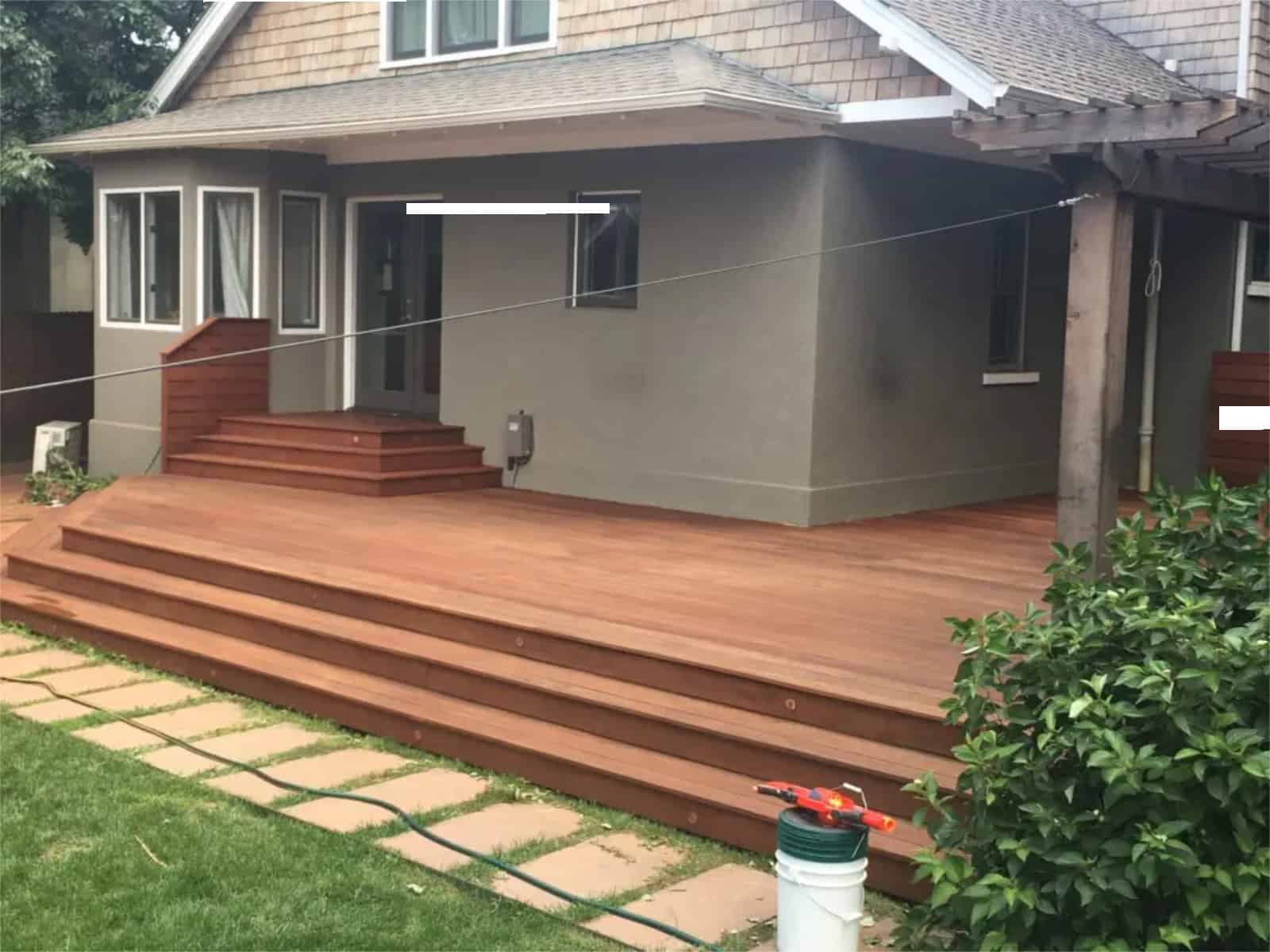
Why Deck Staining Is Different in Louisville
Louisville sits at more than 5,300 feet above sea level, and that elevation changes the math on every finish. UV radiation rises about 2% for every 1,000 feet of elevation gain, which puts local UV exposure near 10% higher than at sea level. The EPA breaks down how elevation intensifies UV exposure in its UV Index guide.
That extra UV, paired with temperatures that swing from below 0°F in winter to the 90s in summer, is hard on unprotected wood. Boards crack, fade, soak up moisture, and grow mildew without a barrier. Moisture that freezes inside the grain expands, then contracts in spring, splitting boards over time.
The right stain, applied correctly, blocks both moisture and UV, and in this climate that protection wears down faster than it does in milder regions. If you are weighing the payoff first, the guide on the benefits of deck staining lays out what the finish actually buys you.
1: Choose the Right Stain Type for Your Deck
Not every stain suits every deck. Your wood’s condition and how much direct sun it gets should drive the choice.
- Transparent stains show full grain with little pigment. They look great on newer decks but give the least UV protection, often needing a touch-up within a year or two in full sun.
- Semi-transparent stains add color while letting grain show, and generally hold 2 to 3 years. This is a common pick for Front Range decks in decent shape that still see heavy sun.
- Semi-solid stains give more uniform coverage with some grain character, lasting 2 to 4 years. They work well on mixed-age boards or moderate wear.
- Solid stains cover the grain entirely and behave closest to paint, hiding damage and weathering. On decks, they can protect 5 to 7 years. For decks in full sun, more pigment means more UV protection, much like a higher-SPF sunscreen.
2: The Best Way to Stain a Deck Starts With Prep
Prep is the best way to stain a deck. Skip it and the finish wears or peels early, no matter how good the product is. Here is what thorough prep looks like, in order.
- Clear the deck of furniture, planters, and grills.
- Inspect for loose boards, raised nails, and damaged fasteners, then repair before staining.
- Clean with a wood deck cleaner to lift dirt, algae, and mildew so the finish can bond.
- Sand rough spots, splinters, and raised grain for even absorption.
- Let the wood dry fully, usually 24 to 48 hours, since stain on damp wood cracks and peels.
- Test by sprinkling water: if it soaks in, you are ready; if it beads, the wood will not take the finish.
If an old coat is flaking, strip it first. A new stain cannot bond to a failing surface, which is one of the most common reasons a job fails early.
3: Application Methods That Hold Up
Once the deck is clean, dry, and repaired, you have three ways to apply stain: brush, roller, or sprayer.
- Brushing gives the most control and works the stain deepest into the grain. Natural-bristle brushes are best for pushing finish into the wood, and the method shines on gaps between boards.
- Rolling speeds up flat areas. Use a 3/16 to 1/4 inch nap on smooth boards and a 3/8 to 1/2 inch nap on rough or textured wood.
- Spraying is fastest and handles railings, spindles, and balusters well, though it takes some practice to control. For most decks, combine methods: roll the flat boards, brush the railings and posts.
Whatever you use, follow each pass with a brush to work the stain into the wood, a step called back-brushing. Stain railings and balusters first so drips fall on unstained boards, and work from the house toward the exit.
4: Timing and Weather on the Front Range
Colorado’s weather puts real limits on when you can stain and get lasting results. Timing is one of the most overlooked parts of the best way to stain a deck on the Front Range.
Apply stain when air and surface temperatures sit between 50°F and 90°F, and keep it out of direct sun. Do not stain if rain is forecast within the next 12 to 24 hours. Midday summer sun is the biggest threat, since stain that dries too fast leaves lap marks.
Early mornings, before the deck is in direct sun, are the most reliable window in warm months. Late spring and early fall are the steadiest stretches in the area. From mid-July through August, fast afternoon thunderstorms can rinse off a coat before it cures, forcing a re-do.
5: Apply Stain Correctly to Avoid Common Problems
Good prep and the right product still need careful application. A few details separate a clean, lasting finish from one that peels in a season.
- Stir often, never shake. Exterior finishes carry a high solids content that settles, and shaking adds air bubbles.
- Test a patch first. Apply to a small, hidden area to confirm color and absorption before committing.
- Follow the grain. Stain a few full boards at a time to prevent lap marks, and keep a wet edge so dried lines never show.
- Do not over-apply. Excess stain stays sticky, then cracks or peels when moisture hits it.
- Handle rags with care. Oil-soaked rags can self-combust, so dry them flat outdoors or soak them in water before disposal.
#6: How Often to Re-Stain a Front Range Deck
Plan on re-staining every 2 to 3 years. Altitude and sun intensity push south- and west-facing decks toward the shorter end of that range.
A simple test: if water still beads on the boards, the finish is working, and you may only need a cleaning this season. When water soaks in and the wood looks gray and dry, it is time for another coat. The best way to stain a deck and keep it protected is to stay on a consistent re-coat schedule.
Harsh winters and dry heat both shorten a finish’s life. Between UV and freeze-thaw cycles, regular maintenance is the most cost-effective way to keep a deck sound.
When It Makes Sense to Hire a Professional
Some homeowners have the time, tools, and setup to stain a deck well. For many others, the best way to stain a deck is to hand the prep and application to a professional, since an early failure costs more to fix than hiring out from the start.
A professional brings the right equipment for every surface, preps correctly for local conditions, and spots structural issues or wood that will not take stain without extra work. The gap between a 2-year result and a 5-year one usually comes down to prep quality and product knowledge.
A New View Painting has been finishing exterior surfaces across the Louisville and Boulder area for over 30 years. Every project starts with a clear scope, cost, and schedule shared upfront, and exterior work is backed by a 4-year warranty that reflects how the prep and application are handled.
Have a fence on the list too? The guides on fence staining cost breakdown and choosing the right fence finish walk through the same decisions for that surface.
Ready to Get Your Deck Done Right?
A well-applied stain protects your investment through Colorado’s full range of conditions, from heavy sun to hard winters. If you would rather hand the project to a team with the experience and equipment to do it right the first time, A New View Painting is ready to help.
Call 970-660-3993 for a FREE estimate today.